Stop Squeezing Your Mangoes: The Counter Is Gaslighting You
Let's be honest with each other for a moment. You've done it. I've done it. We've all stood in the produce aisle of a Kroger at 7 p.m., cradling a mango in our palm like a crystal ball, giving it a hopeful little squeeze and a sniff before tossing it into the cart with the confidence of someone who has absolutely no idea what they're doing.
And then, four days later, we cut into a rock. Or worse — a sad, stringy, sour disappointment that tastes like regret and fiber.
Here's my controversial opinion, and I'm going to die on this mango tree: the squeeze test is a scam, your counter is lying to you, and the American grocery store mango supply chain has been gaslighting us all for decades.
The Color Trap: Why Red Doesn't Mean Ready
Somewhere along the line, Americans got it into our heads that a ripe mango is red. Blame it on marketing, blame it on our deep cultural association between redness and ripeness (looking at you, tomatoes and apples), but it's simply not true for most mango varieties.
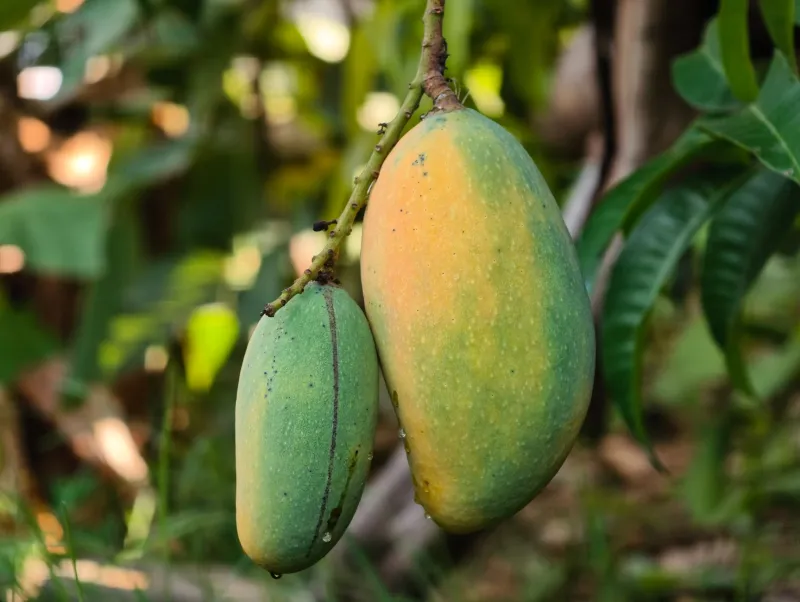
The Tommy Atkins — the workhorse mango you'll find at 90% of US grocery stores, with its pretty red blush — is red whether it's ripe or not. That blush is just sun exposure. It's a tan, not a signal. Meanwhile, some of the most glorious mango varieties on Earth — Ataulfo, Kent, Keitt — stay green or yellow-green even when they're practically pudding inside.
So if you've been passing up green mangoes because they "look underripe," you've been leaving the best fruit on the shelf behind. Green Skin Mango exists partly because of this exact tragedy.
I Called an Importer and Had My World Rocked
I recently chatted with a tropical fruit importer based in Miami who ships mangoes to distributors across the Eastern US, and he confirmed my worst suspicions with the weariness of a man who has explained this a thousand times.
"The mango you buy at the store was picked mature but unripe, sometimes as long as two weeks ago," he told me. "Then it goes into a hot water treatment, gets shipped, sometimes gets hit with ethylene gas to jump-start ripening, and sits in a warehouse. By the time it hits your produce section, its ripening clock is already a mess."
Translation: the mango doesn't know what day it is anymore. It's jet-lagged. And no amount of counter time can fully fix a fruit that's been through that much.
His advice? Buy by feel and smell, not by color. A ripe mango should give gently under pressure — like a ripe peach or avocado, not like a stress ball. And it should smell like a mango at the stem end. That sweet, resinous, almost floral scent is the single most reliable ripeness indicator we have. If it smells like nothing, it will taste like nothing.
The Counter Lie
Now for the part where your counter betrays you. Here's what actually happens when you bring home a firm mango and set it on the counter:
- It ripens unevenly. The side touching the counter softens while the top stays firm, giving you a fruit that feels ripe everywhere except the part you're about to bite into.
- It dries out. Counter air, especially with AC running, wicks moisture from the skin and the flesh beneath it.
- It attracts fruit flies. Do I need to elaborate? I do not.
The pro move is the paper bag method: tuck your mango into a paper bag — optionally with a banana or apple, which are ethylene gas machines — fold it loosely, and leave it at room temperature. Check it daily. Most mangoes ripen in 2–4 days this way, evenly and aromatically.
Once ripe, move it to the fridge. Refrigeration halts ripening, so it's the destination, not the journey. A ripe mango will hold in the fridge for about 4–5 days.
Your Screenshot-able Mango Ripeness Cheat Sheet
Save this. Tape it inside a cabinet. I won't judge.
| Signal | Underripe | Perfectly Ripe | Too Late |
|---|---|---|---|
| Feel | Rock hard | Gives gently, like a peach | Mushy, sunken spots |
| Smell (stem end) | Faint or grassy | Sweet, floral, resinous | Fermented, boozy |
| Color | Ignore it entirely | Ignore it entirely | Black or heavily shriveled |
| Weight | Light for size | Heavy for size | Heavy but soft all over |
Yes, that middle row says "ignore it entirely" twice. That's the point. Color is a mango's least trustworthy feature, and I will not be taking questions.
Rescuing a Bad Mango (Because We've All Been There)
Cut into a mango and discovered a crime scene? Before you compost it, try one of these:
- Sour and firm: Dice it and use it like a green mango — toss with lime juice, chili powder, and salt for a Mexican-style snack, or blitz it into a tangy chutney.
- Fibrous and stringy: Blend it. Fibers vanish in a smoothie or strained through a fine-mesh sieve for lassi.
- Bland but soft: Roast it. A drizzle of honey (or agave for the fully plant-based crew), a sprinkle of salt, and 400°F for 15 minutes concentrates the sugars beautifully.
- Slightly overripe: It's banana bread time, but mango. Mash it into quick bread or muffin batter with cardamom and lime zest. You're welcome.
The only truly unrecoverable mango is a fermented, boozy-smelling one. That fruit has moved on. Let it go.
The Bottom Line
Stop shopping with your eyes. Shop with your nose and your palms like some kind of produce sommelier. Buy firm mangoes if you're not eating them this week, ripen them in a paper bag, and refrigerate the moment they soften. And when you find a truly perfect mango — heavy, fragrant, giving like a secret — stand quietly in your kitchen and eat it over the sink.
You've earned it. You survived the Great Mango Ripeness Debate.