Papaya Doesn't Hate You — Your Grocery Store Does
Ask ten Americans about papaya and I promise you at least seven will make a face. Not a polite face. The face. The one that says I tried that at a hotel breakfast bar in Cancun and I have not recovered.
And here's the thing: I get it. I really do. Because the papaya most of us encounter in the wild is a flavor crime — and not one the papaya committed.
The Truck Is the Problem
Here's how the papaya supply chain actually works for most of the country. The fruit gets picked, packed into a refrigerated truck, and shipped thousands of miles while cold air actively suppresses the enzymes that develop its flavor. Then it arrives at your supermarket looking sort of peach-ish and sad, gets displayed at room temperature for a few days, and you take it home thinking it's ripe.
It is not ripe. It has been thawed into compliance. A papaya that ripens on the tree develops this honeyed, musky-sweet thing going on. A papaya that ripens in a 55-degree truck develops... texture. That's it. That's the whole experience. It tastes like melon that got distracted.
This is roughly the same problem we've documented before with mangoes and avocados — the tropical fruit shelf is where flavor goes to be negotiated down — but papaya might be the biggest casualty of all, because its best qualities are the most fragile ones.
My Extremely Unscientific Papaya Taste-Test
To settle this, I bought papayas at four stages of "readiness" and subjected my household to a blind-ish tasting. Results below, rated on a scale of "why" to "genuinely moving."
Level 1: The Rock. Yellow-green, hard as a billiard ball. Cutting into it was a workout. Flavor: cucumber with ambition. Texture: squeaky. My partner said, "I don't think this is food." Correct.
Level 2: The Truck Survivor. Mostly yellow, slight give, purchased from a big-box grocery in the Midwest. This is the papaya that's ruining the fruit's reputation. Faintly sweet, faintly musky, mostly wet. Tastes like the idea of papaya. If your only papaya experience looks like this, I'm sorry, and I understand your face.
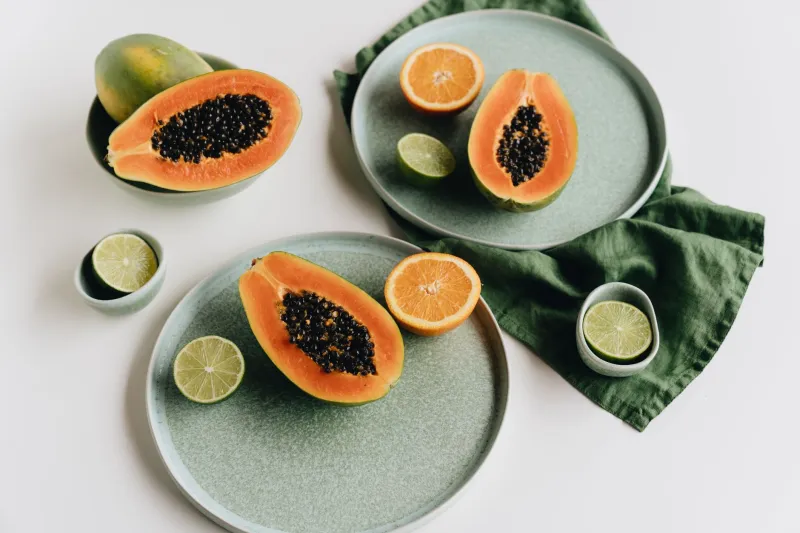
Level 3: The Patient One. Bought firm, left on my counter for five days until it went deep golden-orange and gave like a ripe avocado. Now we're talking. Floral, honeyed, with that musky edge that papaya fans chase and papaya haters fear. The difference between Level 2 and Level 3 is the difference between a tomato from the garden and a tomato from January.
Level 4: The Fanfare. A small Hawaiian papaya (more on sourcing below) that ripened fully on the counter and practically split its own skin. This one got scooped straight out with a spoon, no chopping, no sharing. Custard texture. Sweet with a citrusy finish. This is the papaya that exists in tropical postcards. It was worth every awkward day it sat on my counter judging me.
The Lime-and-Salt Situation
Now, even a perfect papaya benefits from the single greatest fruit hack that hasn't fully crossed over into mainstream America yet: a squeeze of lime and a tiny pinch of flaky salt.
This is standard practice across Mexico, Southeast Asia, and basically everywhere papaya grows naturally, and it works for a real chemical reason. Papaya is low-acid, which is part of why it can taste flat or one-note. Lime floods it with the acid it's missing, and salt suppresses the bitter compounds while amplifying the sweet ones. It's the same principle as salt on watermelon, except it matters even more here.
The transformation is not subtle. A mediocre papaya becomes a good papaya. A great papaya becomes the best thing you eat all week. I have watched self-described papaya haters go back for seconds after the lime treatment, and I consider this my life's work.
Bonus move: a little chili powder or Tajín on there. Green Skin Mango readers know I don't shut up about fruit plus chile, and I'm not going to start today.
Where to Find the Good Ones
Okay, logistics. Three routes to papaya redemption:
Hawaiian papayas. The small solo varieties (look for the word "solo" or brands like Rainbow and Kapoho) are the gold standard and do ship to the mainland. They're smaller, which is good — you'll actually finish one before it turns. Online specialty grocers and some natural foods stores carry them.
Florida-grown. South Florida grows real papayas, especially around Homestead, and farmers markets in the Southeast and up the East Coast occasionally get them fresh. If you see a Florida papaya at a market, that fruit has not suffered the truck. Buy two.
Your own counter. Whatever you buy, buy it firm and green-shouldered, bring it home, and let it ripen fully at room temperature — days, not hours. It's ready when it's mostly golden and yields to gentle pressure like a ripe avocado. Never refrigerate before it's ripe; the cold is the whole enemy.
The Verdict
Papaya doesn't have a flavor problem. Papaya has a logistics problem, a patience problem, and a seasoning problem — all three of which are fixable in your kitchen this week. Buy firm, ripen slowly, hit it with lime and salt, and if you can swing it, source one from Hawaii or Florida that actually got to finish its own business on the tree.
The face you make at papaya can change. I've seen it happen. It starts with a lime wedge.